

The 10-Year "Fragile Window" for Cardinal Health Leaders
When you are climbing a mountain, your primary focus is on the ascent. But statistically, most mountaineering accidents happen on the way down.
Retirement planning works the exact same way.
During your accumulation years at Cardinal Health, market downturns are actually a hidden gift. When you drop money into your Cardinal 401(k), HSA or deferred comp, a down market means you are buying more shares of great companies at a steep discount. You want low prices because it juices your long-term compounding.
But as you approach retirement, the math completely reverses.
Why Average Returns Are a Lie
If you have been prudent with your ongoing savings, most retirement calculators will tell you that if your portfolio averages a 6% annual return over 30 years, your plan will succeed. Mathematically, that is a dangerous assumption.
The order of those returns matters much more than the long-term average.
When you retire and begin withdrawing income from your portfolio, a down market forces you to sell shares at depressed prices. To get the same dollar amount for your living expenses, you have to sell more shares than you would have if the market were flat or up.
This permanently guts your share count, shrinking the asset base that is left to recover when the market eventually bounces back.
The chart below illustrates this dynamic perfectly. It models portfolios based on an average return of 6% over 30 years (360 months), starting with a base value of $100,000.
- Without Withdrawals (Dashed Lines): Look at the top two lines. The "Bear Market First" scenario hits a 3-year bear market right at the beginning, while the "Bull Market First" scenario hits it at the very end. If you aren't touching the money, the sequence doesn't matter: both portfolios end at the exact same value.
With 5% Withdrawals (Solid Lines): Now look at the bottom two lines. When a steady 5% annual withdrawal is introduced, the paths diverge drastically. The portfolio that enjoys a "Bull Market First" withstands the draws and leaves a substantial nest egg. Meanwhile, the portfolio that encounters a "Bear Market First" structurally degrades so fast that it runs out of money entirely before the 360 months are up.
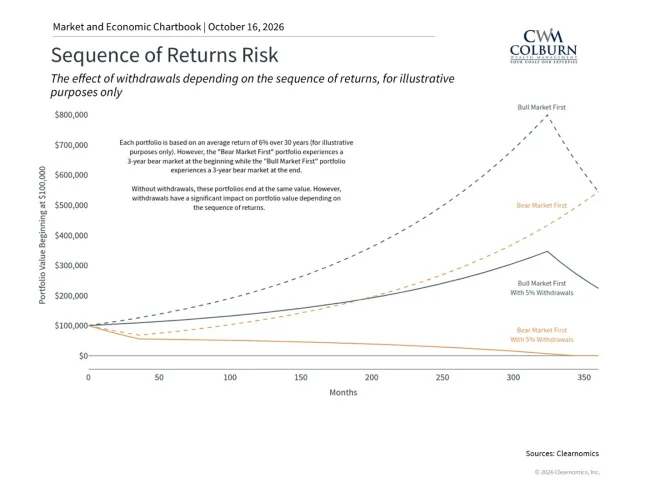
The takeaway is stark: the exact same average return can produce a highly successful retirement or leave you with a depleted balance sheet, depending entirely on when the bad years hit.
The "Fragile Window" for Cardinal Health Leaders
In financial planning, the five years before and the five years after your retirement date are known as the Fragile Window or Fragile Decade. This ten-year corridor is when sequence of return risk reaches its absolute peak.
A severe market downturn during this specific transition phase can inflict permanent structural damage on your net worth.
For Directors, VPs, and long-tenured professionals wrapping up a career at Cardinal, this systemic risk is heavily amplified. Your exposure may extend beyond standard retirement holdings like the 401(k), HSA, or deferred compensation plans.
Holding concentrated, unhedged positions in CAH stock at the exact moment you transition to retirement exposes your balance sheet to dual volatility. Managing this specific operational bottleneck requires a tactical approach.
The Five-Step Insulation Process
You cannot control what the market does during your first year of retirement. But you can completely control how vulnerable your balance sheet is to it.
To insulate your hard-earned wealth from a bad sequence of returns, we focus on five core operational steps:
- Establish a Multi-Year Cash Buffer: Instead of selling equities when the market drops, we establish a dedicated cash and short-term fixed income buffer (typically 3 to 5 years of lifestyle expenses). If a bear market hits, your lifestyle is funded by cash, giving your stock portfolio room to recover without forcing liquidations.
- Execute an In-Service Distribution at 59½: Don't wait until retirement to build an insulation strategy. Once you hit age 59½, you can move assets out of the CAH 401(k) and into an IRA via an in-service distribution. This allows us to build deep, global asset diversification—even within the stock portion of your portfolio—well beyond the limited menu of institutional funds in the Cardinal Health programs.
- Implement Dynamic Spending Guardrails: Portfolio survival isn't just about what you invest; it's about how you adapt. We establish pre-agreed rules before your retirement date. If a severe bear market strikes during your Fragile Window, you temporarily trim discretionary spending—like luxury travel packages—by a minor, predefined percentage (typically 10% to 15%). Once the market recovers, your baseline spending safely scales back up. This simple, temporary guardrail completely alters the portfolio math, ensuring you never over-liquidate assets during a temporary market downturn.
- Implement a U-Shaped Allocation Strategy: To protect the "Fragile Window," we typically dial back a client's overall stock exposure in the immediate years leading up to retirement. However, once you successfully navigate that 5-year post-retirement window, your risk profile changes. Depending on retirement age, you often transition onto Medicare (dropping your healthcare costs) and turn on Social Security. These stable income sources lower your portfolio draw rate, significantly reducing sequence risk and allowing us to safely increase your stock allocation again to build long-term wealth that beats inflation.
- Leverage the Partial Retirement Buffer: As covered in last week’s newsletter, according to recent J.P. Morgan research, 53% of American households don't retire all at once. For those interested, phasing down your responsibilities or taking a scaled-back role provides a steady income stream that automatically lowers your initial portfolio withdrawal rate, acting as an organic insurance policy against a bad market sequence.
While an average return looks great on a spreadsheet, real-world retirement cash flows need a much closer look. The math behind sequence risk can seem a bit intimidating at first, but the solution isn’t to fear the markets—it’s just to out-engineer them with a smart descent route. Taking the time to insulate your hard-earned nest egg during this critical ten-year corridor changes the game. It ensures that your transition down the mountain of corporate life is a deeply rewarding next chapter defined by flexibility and excitement, rather than financial anxiety.
If you ever want to talk through your Cardinal benefits, retirement planning, or LTI decisions, you’re welcome to schedule a Q&A. No cost, no pressure, and no expectation to meet again — just a chance to talk things through. SCHEDULE A 30-MINUTE CARDINAL Q&A
Take care and, as always, stay the course.
Join The Cardinal Clarity Weekly
Colburn Wealth Management, LLC is a registered investment adviser. Information presented is for educational purposes only and does not intend to make an offer or solicitation for the sale or purchase of any specific securities, investments, or investment strategies. Investments involve risk and, unless otherwise stated, are not guaranteed. Be sure to first consult with a qualified financial adviser and/or tax professional before implementing any strategy discussed herein. Past performance is not indicative of future performance.