

The Market Keeps Chugging Along
Imagine that before the year started, you knew with certainty that the following things would happen during the first five months of 2026:
- Inflation would hit a three-year high and continue climbing.
- The Fed would halt all rate cuts.
- Warnings of stagflation would intensify.
- Significant stress would build in the world of private credit.
- Concerns about A.I. disrupting the job market would accelerate.
- The U.S. would go to war with Iran, increasing unrest in the Middle East, not to mention the U.S. military capture of the Venezuelan dictator.
- Oil would surpass $100 per barrel.
- Gas prices would jump from less than $3 per gallon to more than $4.50.
- Tariffs would be ruled unconstitutional, only to be reenacted under different legislation.
- Consumer sentiment would hit a 70-year low.
- We could go on…
Seriously, pause for a moment and think about that list. If someone had shown you those headlines on January 1st and asked you to predict what the stock market would do, what would you have said?
I’m guessing you wouldn’t have predicted strong returns. In fact, I think most people would understandably have guessed that we’d be headed toward a recession, a bear market, or some kind of financial crisis.
And yet, that’s not what has happened, at least not so far. And it’s not even close.
One major reason the markets have done so well is that corporate earnings have continued to come in much stronger than most anyone expected—once again growing more than 12% in Q1, marking the sixth straight quarter of double-digit earnings growth—and this is coming off an already historically high base.
Then, of course, there’s the A.I. story where a relatively small group of large technology companies continues to drive a significant portion of market returns as investors bet that artificial intelligence could meaningfully reshape productivity, profits, and business growth over the coming decade.
Whether that bet comes to fruition or not, nobody knows. But either way, I think it’s important to acknowledge that while the negative headlines have been surprising, the strength of corporate earnings and the market’s enthusiasm around A.I. have been equally surprising.
Which is one of many reasons that forecasting the market is so difficult (if not impossible) because surprising things—both good and bad—happen all the time. And we should expect more of the same because, as Daniel Kahneman said, “The correct lesson to learn from surprises is that the world is surprising.”
In other words, as much as we might like to assume that bad news should lead to bad outcomes and good news should lead to good outcomes, this isn’t necessarily how things work. The markets and headlines are usually far too mixed for the future to become obvious in the short term.
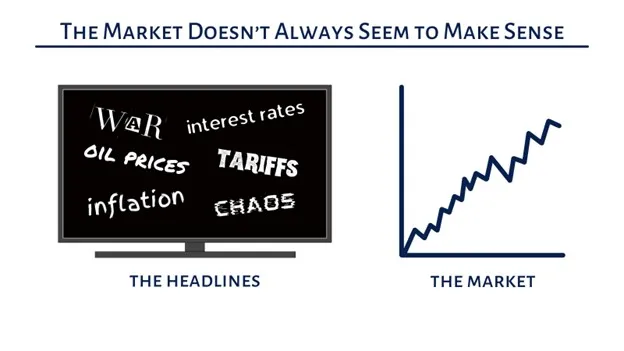
That being the case, my main point here is simply that the connection between headlines and market outcomes is far weaker than most people assume.
That’s because businesses aren’t static entities; they’re adaptive. Economies grow because companies innovate, solve problems, and become more productive over time. And over the long term, these broad trends have generally been quite positive.
As a result, the market has moved higher over the long run as well.
For what it’s worth, I’m not saying the market will keep rising for the remainder of the year. I don’t know what will happen next (nor does anyone else), but I do think 2026 has already provided a powerful reminder that the market has an incredible ability to surprise the greatest number of people.
And perhaps more importantly, that headlines alone are often a terrible guide for investment decisions.
If you ever want to talk through something you read here or have a question about your own situation, you’re welcome to schedule a brief, free Q&A conversation: CLICK HERE
Take care and, as always, stay the course.
Colburn Wealth Management, LLC is a registered investment adviser. Information presented is for educational purposes only and does not intend to make an offer or solicitation for the sale or purchase of any specific securities, investments, or investment strategies. Investments involve risk and, unless otherwise stated, are not guaranteed. Be sure to first consult with a qualified financial adviser and/or tax professional before implementing any strategy discussed herein. Past performance is not indicative of future performance.